


Why the best emerging managers are misreading social media and what it’s costing them
By Claudia Quintela and Melanie Goodman
A respected hedge fund journalist recently called one of the sharpest macro writers working today an “influencer.”
The writer in question runs serious money and publishes genuine research. He is not selling a course. He is not flogging a trading signal to retail. He is telling you what he sees in the market and how he thinks about it. And a senior figure in the industry looked at that and reached for the most dismissive word he could find.
I chose not to publish the specific post here to protect both parties. But I had to sit on my hands. Because the instinct behind the word “influencer” is exactly the instinct keeping good managers invisible, and it is wrong.
This piece is about that instinct. Where it comes from, and what it is costing you. I will make the strategic case, because I have watched how capital actually moves for long enough and I have now watched it move toward me through a channel I used to dismiss. Melanie will handle the mechanics, because building authority on LinkedIn is what she does for a living and I am not going to pretend otherwise.
The operator is not an influencer
There is a distinction the industry keeps refusing to make, and it matters.
An influencer sells you something. The product is financial, retail, and the audience is the revenue. A brokerage referral, a paid community, a “system.” The content exists to convert strangers into customers of the content itself.
An operator is running a business, building a fund or allocating capital, and happens to write in public about what that work teaches them. The content is a by-product of the real job. There is nothing to buy. There is only a mind, shown working.
The operator is not a creator. The operator is a practitioner who decided to stop hiding the practice. That is a different thing entirely, and conflating the two is lazy.
Bill Ackman is the obvious example at the top of the market, a public figure whose influence now runs heavily through his own platform rather than through a journalist’s framing. On the smaller hedge fund side, Alfonso Peccatiello, “Alf,” built a following most hedge funds would envy on X writing macro, then moved his main work to Substack and LinkedIn. Neither of these men is an influencer. They are operators who understood where the conversation moved.
The reason the slur stings is that everyone in our generation was trained to feel it. Which is the real problem.
We were trained to disappear
Look at how people of our cohort were trained to operate.
Be discreet. Say nothing that has not been vetted. Influence happened in rooms and over dinners, across a handshake and a business card. Visibility was vulgar. The serious money was quiet money and quiet meant credible.
That world has not gone. It is shrinking, and the people who will decide your fund’s future increasingly did not come up in it.
The senior name signing off still remembers business cards and the Financial Times over breakfast. The people feeding them the shortlist do not. The analyst whose read of you reaches the decision-maker before you do. The next-gen heir starting to steer a family office. They built their view of the world on a screen, reading and watching, on YouTube and Reddit and LinkedIn and X. They research a manager the way they were raised to research everything, quietly and online, months of you before anyone raises a hand.
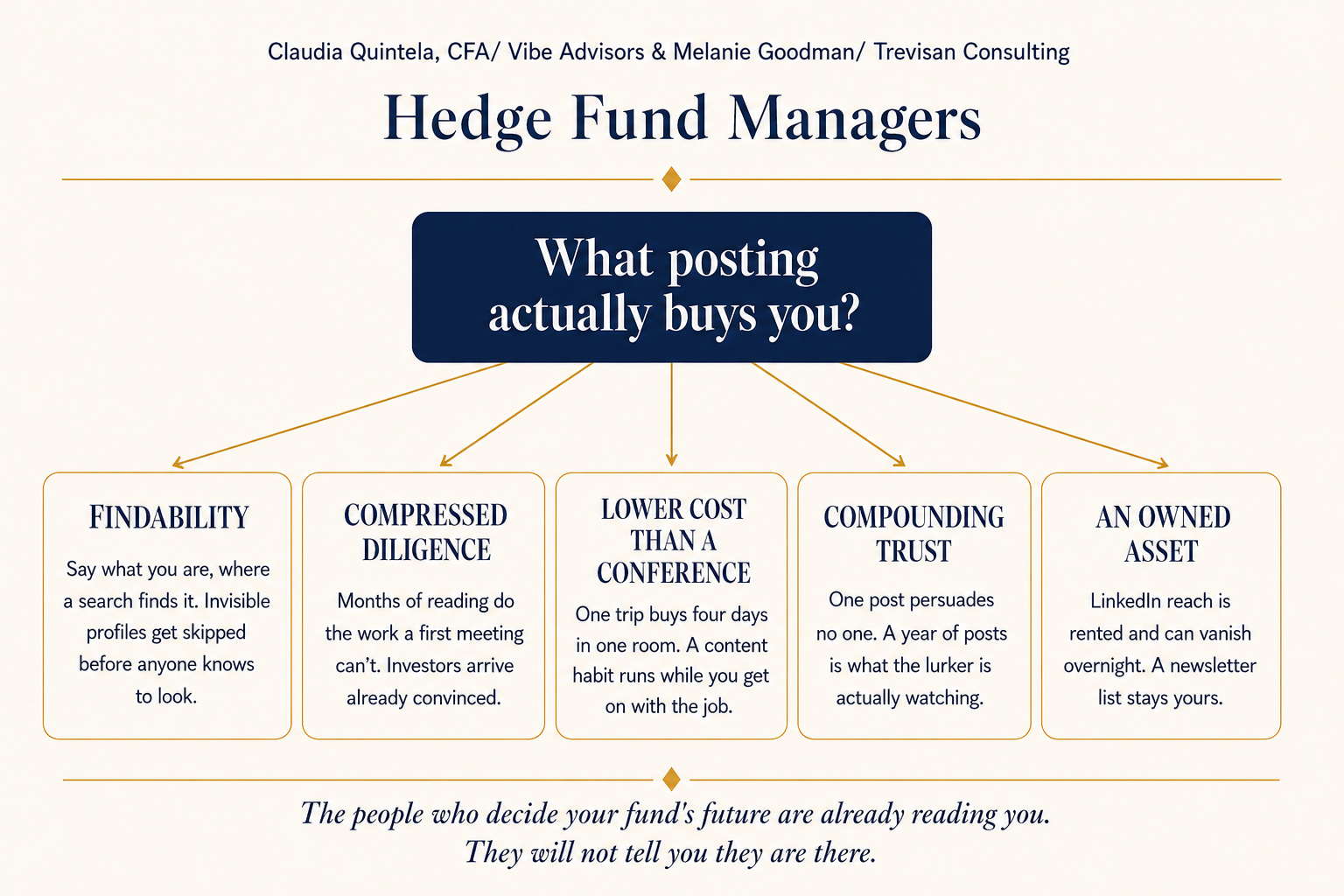
They will find you before they ever meet you, the way they find everything, by searching and reading from a distance. Most of the verdict is in before you learn they exist. If you are not there to be found, you are being skipped, and you will never know you were.
So the discretion that once signalled seriousness now mostly signals absence. You are being missed.
LinkedIn is where these decision-makers are. Not all of them, not always, but enough of them that refusing to be there is a choice with a cost and most managers are making that choice without ever calculating the cost, because it feels safer to say nothing.
Silence feels safe.
The inbound arrives already convinced
I did not arrive at this as a believer.
I am not a content person. I do not write about platforms or growth. I started writing in public reluctantly, under no name at all for the first year or so, because I was embarrassed. I am still not especially consistent. I am trying to write three times a week on LinkedIn and put real effort into long-form, and that is the whole programme.
And the inbound has been relentless. Investors and managers both. Through the website and the booking links.
The surprise was the stage at which it arrives.
People reach out having already consumed hours of what I have written. They arrive at the first meeting feeling like they know me. I am treating it as a first conversation, because to me it is. To them it is nothing of the sort. They had read me for months and decided I was worth their time before I knew they existed. The qualification happened without me.
That compresses everything. The slow, expensive work of a first meeting is establishing who you actually are, and whether you are someone they can sit across from for years. You cannot reliably do that in an hour. You can do it across months of someone reading you, without spending a single one of those hours yourself.
Melanie tells the same story from a networking event, where strangers approached her certain they had met, because they had been watching her videos for months. She had no idea who they were. They felt they knew her completely. That asymmetry is the entire opportunity.
The result, for me, has been investors arriving with a mandate and asking who fits it, and managers arriving so aligned on how they run and how they communicate that we are working together within weeks. Fast, in a business that is not supposed to move fast.
I am being deliberately vague on the specifics, because some of this is confidential and all of it is somebody else’s business. But the pattern is consistent enough that I no longer think it is luck.
Why hedge fund content works on a different clock
This is the part nobody seems to get right, so I want to be precise about it.
Most of what gets written about social media for finance is really written for venture and venture investors behave in a way that is almost the opposite of hedge fund investors, for a structural reason that has nothing to do with personality.
VC is closed-end. There is a fund, it is raising, the window shuts. The deals are time-sensitive. Miss the round and you miss it. So VCs broadcast. They post that they are in a city this week, hunting actively, because the rush is real and being visible feeds the funnel.
Hedge funds are evergreen. The structure is open-ended. The fund is, in principle, always open. Which means nobody has to rush, ever. An allocator can come in now or in eighteen months, and coming in later, once you are proven, often carries less risk. There are incentives for seeders and early backers, but there is no “in now or never in.” So the investor waits. They wait until they are fully convinced you are worth the dedication of their time and capital.
That single structural fact changes the entire content game.
It means hedge fund investors do not advertise themselves. They have no reason to. There is no round closing. So they lurk. They watch you, with no intention of raising their hand, for as long as it takes to be sure. And they reach out only when they have seen enough, in their own time, when something you wrote finally tips them.
In hedge fund land, it pays to lurk. Going first carries no reward, so the smart capital stays silent and observes. Which means your content is not performing to a crowd that claps. It is performing to a gallery you cannot see, who will never react, and who are forming a verdict anyway.
This is where managers get it backwards. The metrics will look quiet, and that is fine, because you are not playing to the visible audience. The silence is the mechanism doing its job. The only thing that moves a lurker is the accumulation of evidence over time. One post does nothing. A year of posts builds conviction.
This is why the impatient give up at the exact moment it starts working. They are reading a closed-end playbook in an open-ended world.
The two things stopping you, and why neither holds
When I push managers on this, it always comes down to two objections. I have made both myself, so I am not unsympathetic. They are still wrong.
“I don’t have the time.”
You are a founder doing ten thousand things. Fair. So let me put it in terms of cost.
You will fly to Miami in January for four days of conference. Build in the prep, the travel, the recovery, the follow-up, and you have spent the better part of three weeks of your year on it. For an upside that is capped: you meet whoever is in the room, and that is the ceiling.
Now compare that to setting up a content infrastructure once and letting it run. Record your investment committee meetings with your colleagues and talk about what came up. Say what you are seeing in the market this week. Describe your actual day. You do not need to perform. You need to be consistent, and the polish comes later. The work mostly already exists; you are just declining to show it.
Keep the conferences. Just build the always-on version first, or your priorities are inverted.
“It’s embarrassing. It’ll make me look low-value.”
I understand this one in my bones. I hid behind no name for over a year. The fear that being visible online is beneath a serious person, that it cheapens you, is real and it is widely held.
It is also a misread of who is watching. The downside of a low impressions post is nothing; almost nobody sees it and you are no worse off (momentary personal disappointment aside). The upside is that the one allocator who matters reads it and remembers. A post seen by three hundred people is worthless if it was the wrong three hundred, and priceless if one of them runs a mandate you fit. You are leaving a trail for the people already looking for someone like you.
The metrics will lie to you
While we are here: stop watching impressions.
Reach across LinkedIn is broadly down on where it was eighteen months ago. People who once pulled five thousand views now pull five or six hundred and panic. That is normal now. Melanie will tell you the same, and she lives in this data.
I have had posts hit fifty thousand on a following of a few thousand. I have had posts disappear. Neither told me much. The only questions worth asking are whether the writing is pulling the right people closer. Newsletter subscribers. Inbound from someone who matters. A viral post that floods you with irrelevant connection requests from the other side of the world is a vanity metric. The quiet post that one allocator screenshots is the one that pays.
Consistency beats spikes. “Your posts keep coming up” beats one good day. The compounding is the point, but it is invisible until it is not.
If you won’t say what you are, you don’t exist
One last strategic point before Melanie takes over on how to actually do this.
A lot of managers are so afraid of the label that they refuse to plainly state what they do. They will not write “hedge fund manager” or “allocator to emerging managers” anywhere a search engine can find it. The result is brutal and simple: when someone goes looking for a hedge fund manager in Milan, or an allocator in their strategy, you are invisible. You have optimised yourself out of the search.
Say what you are. Clearly, in the places that get indexed and read. Being findable is the bare minimum for being considered at all. If the lurkers cannot find you, they cannot lurk on you, and the entire machine never starts.
How you actually build that presence, position it so the right people find you, and keep it running without it eating your week, is Melanie’s territory. Over to her.
Set up so the right people can find you
Claudia is right that the people who will decide your fund’s future are already looking at you online. Most allocators and family office analysts will glance at your LinkedIn profile before they commit to an hour on a call or a flight to London. A vague or generic profile, or one obviously written for job-hunting, gives them a reason to move on.
An absent one gives them nothing to move towards.
Think about how a family office analyst actually searches. They do not type “inspirational macro thinker.” They type “emerging hedge fund manager global macro London,” or “allocator to emerging managers family office Zurich.”
If you do not appear in that search, you have opted out of a conversation you never knew was happening.
A clean operator profile has little to do with polish. Its job is to let serious capital find you and understand you inside two minutes.
Your headline decides whether you surface at all. “Partner at XYZ Capital” tells an allocator almost nothing. “Emerging hedge fund manager. Global macro. London.” tells them who you are, what you run, and where, which is exactly what they searched for. Combining role, strategy and location is the single highest-return change most managers can make to a profile.
Your About section should state your mandate and who you serve, in one or two short paragraphs. It needs to answer three things.
What you run or allocate to, in high-level terms.
Where your capital comes from, whether that is family offices, institutions or ultra-high-net-worth individuals.
How you think about risk, liquidity and time horizon.
Mirror the language you already use on your website and in approved materials. You do not name individual private funds, you do not quote performance and you do not promise outcomes. You describe how you operate.
Your experience should read like the front page of a due diligence pack rather than a curriculum vitae. An allocator reads it to assess you, the way they would read a screening memo. Each role should summarise the firm, your function, the strategy focus and the type of investor, in two or three sober lines. Use the language your deck uses. Avoid anything that reads like a pitch.
Your Featured Section is where a lurker finds something to read. If an investor lands on your profile and there is nothing to click, they cannot build conviction. Three to six pieces is enough: a research note, a macro commentary, an investor letter, a panel clip, a Substack article. One hedge fund client of mine moved from no inbound at all to regular conversations with family offices after we did nothing more than pin his existing quarterly letters and a talk video. The thinking was already there. It had simply never been visible.
Your profile should connect plainly to your firm and make you reachable. Link your current role to the firm page. Describe the business neutrally in your About section. Point to the firm site from featured. Then keep the basics in order: a professional headshot, an understated banner, a sensible headline, a custom URL (crucial in 2026 for AEO and SEO) and visible contact details. One allocator I work with has a simple rule. If they cannot reach you in two clicks, they shelve the idea and move on.
An allocator has perhaps two minutes between meetings. A profile that covers those points is one they can forward to an investment committee without hesitation. Anything less leaves you depending on luck and conferences to do the work a profile should be doing for you.
What an operator actually posts
Once your profile stops hiding you, the question is always the same.
What can I say without looking like a marketer or stepping on compliance?
You do not need to become a content creator.
You need to let the work you already do reach the public record. For most operators that means one or two posts a week, drawn from what is already on your desk.
The posts that earn attention from serious capital tend to fall into a few types. There is the short market lens: what you are watching this week and why, written the way you would explain it to a sober allocator. There is the occasional framework post: how you think about risk, liquidity, sizing or manager selection, without numbers. There is the view from inside the investment committee: a question that split the room, a decision that took longer than it should have, a trade you walked away from. If you sit on the capital side, there is the allocator’s perspective: what earns a manager a second meeting, what ends the conversation, what you wish managers understood.
None of that requires performance data or trade specifics but all of it signals how you think.
One London allocator I work with started sharing anonymised versions of the questions they put to managers at a first meeting. The inbound that followed was better qualified. Fewer calls went nowhere.
Tone is the guardrail. You are not performing but are writing the way you speak in a serious investor meeting: precise, caveated, rooted in process rather than drama. There is a simple test before you post anything.
If the lines would sit comfortably in an investor letter, they will sit comfortably on LinkedIn. If they would look absurd in that letter, they are influencer content… and you already know it.
Cadence and the no-time problem
You are a founder or a portfolio manager with no spare hours. You do not need many. You need rhythm.
A realistic operator cadence is one or two short LinkedIn posts a week, each drawn directly from work that is already happening: an investment committee discussion, a risk memo, a call that raised an interesting question, a note from a conference. On top of that, one longer newsletter piece a month, which becomes the spine of everything else.
The way you sustain this is to treat content as a by-product rather than a project. The raw material already exists in your notes, your minutes, your slides and your call summaries. Once a week you turn one of those into a post, which takes about ten minutes. Once a month you gather a cluster of those themes into something deeper.
The compounding happens while you get on with your actual job. In an evergreen structure, that familiarity does not close a round. It makes you the obvious name when a family office finally decides to allocate to your strategy.
The minimum that still works is modest. One weekly post and one monthly long-form piece. More is welcome. That alone is enough to leave a trail worth following.
Handling what comes back
Do this even moderately well and things start to move.
The inbound will not arrive as a tidy list of allocators.
It arrives as a jumble of serious capital, peers, vendors, recruiters, retail investors and coaches. Treating all of it the same is how you lose your week.
A simple triage holds up well:
Priority: allocators, family offices, institutional investors, strategic advisers.
Defer: interesting peers, media, and longer-term relationships that may matter later.
Decline: clear sales pitches, irrelevant strategies or geographies and anything that plainly is not a fit.
Respond promptly and properly to serious capital. Reply briefly and politely to everyone else, perhaps with a link to your newsletter and an honest “not a fit right now.” Do not let your direct messages become your calendar.
Volume can be deceptive here and it is worth bracing for. The post I made on my birthday a few weeks ago reached around two hundred thousand people. It took three minutes to write and was nothing more than a photo and a few lines. The connection requests that followed were mostly irrelevant, from people and places with no bearing on my work, and I declined most of them with a short standard reply. It produced no clients. The reach was the least useful thing about it.
The requests that matter look unremarkable by comparison. Someone has read you for months, on LinkedIn and in your newsletter, and arrives already convinced. Your task is to recognise those messages and move them into a serious channel: a call, a meeting, a proper due diligence process. The asymmetry Claudia described is the whole point. They know you. You are meeting them for the first time. Treat that as the advantage it is.
The LinkedIn and Substack flywheel
Most people in finance treat LinkedIn and a newsletter as separate worlds. For an operator they are two halves of the same decision.
LinkedIn is your discovery layer. It is where a chief investment officer first sees your name in a comment on a peer’s post, or a family office analyst notices a market note someone has shared. It is where they watch your tone and your consistency before they have any intention of contacting you.
Your newsletter is where the real diligence happens. It carries the pieces that are too long or too specialised for the feed: the macro letters, the allocation frameworks, the manager-selection philosophy. It is also the one part you own. If LinkedIn changed its rules tomorrow, or restricted your account, your subscriber list and your ability to email it would still be yours.
The loop runs in one direction. You publish a substantial piece in the newsletter. You take three or four LinkedIn posts out of it over the following week: a chart, a short excerpt, a question you posed to investors, a single takeaway. Each post points gently back to the full argument, with the link in the comments or your featured section. The people who care click through, subscribe and read you in full. Many will never react. They will watch. Months later, when their mandate and your strategy line up, they surface, having effectively pre-qualified themselves.
The platform you send from matters more than most managers expect. My weekly email goes out to around five and a half thousand people and opens at roughly 52 to 53 per cent. My Substack posts reach a far larger list and open between 20 and 30 per cent, which is normal for a publication of that size. The point is ownership. An engaged, owned email list will almost always outperform a borrowed feed, and it is the asset you can rely on when everything else shifts.
Your LinkedIn audience is rented. Your newsletter audience is yours. The flywheel exists to move the right people from the rented feed to the owned list, and from there into conversations that change the trajectory of your fund.
This is the system I build with clients in my CPD-accredited LinkedIn training, and write about in The Link Tank: a presence allocators can read for months, and a home base they trust once they decide to reach out.
Claudia, to close.
The people who will decide your fund’s future are already reading you. They will not tell you they are there. They will not react, and they will not clap. They will surface, fully convinced, on a Tuesday you have long forgotten you posted anything at all. The only question that matters is whether there was anything there for them to read.
Start before the next conference, not after it.
For Mel & Claudia, it's all about that one line - being found by the right people.
The point about VC being closed end and hedge funds being evergreen changes how I think about content.