

There is an incredible amount of ChatGPT-generated BS in managers’ materials right now, and more and more of it sounds exactly the same. It looks the same too. Same fonts and colour combinations, every page crammed to the edges. When I wrote about the sameness problem in Issue 4, it was mostly about copy: everyone claiming uncorrelated returns in the same order, with the same performance chart on page six. Since then the design has caught up. I get ten or more manager approaches a week, and I open most of the documents with the same reaction: oh, another one of these.
I’m a very visual person, so even when the copy is different, I’ve decided I’ve seen it before I’ve read a word. Managers used to build their own decks in PowerPoint, and they were ugly in a hundred different ways, but each one was ugly in its own way. If somebody sent me a pink presentation tomorrow I would remember it, and I don’t even like pink.
If you’ve been in this industry long enough, you remember the RFP game. Twenty-five years ago firms kept RFP databases, logged their answers and pasted the same responses into every RFP and consultant database they submitted to. The language was clinical and any personality had been scrubbed out before the documents left the building. We’re heading back there, faster.
Managers produce their materials with AI, and allocators are starting to use AI for the first screen of what comes in. Put email agents on top of that, and everyone trying to spend less time reading email, and the first conversation between a manager and an investor is turning into a bot talking to a bot. A due diligence specialist I know reads every DDQ and offering memorandum that crosses his desk. He can tell which ones went through a chatbot from the flatness of the phrasing. So when do the humans get involved, and how much of you is still visible in the documents when they do?

Words first, then design
If you’re preparing marketing materials the most important thing is the copy, your words and your message. Write the words first and get them right. This should involve you and your partners talking about what makes you unique and what the important points are to get across in your story. Claude and ChatGPT cannot do that for you. They can improve whatever story you came up with, but the start always has to be you.
Then design, separately, and check that you haven’t picked the same combination as the last forty managers. Do the colours say anything about you or your firm, or are you using them because Claude suggested them? Same question for the fonts.
And check whether anyone can read it. Is it just me? I’m 50 now and I can’t read **** on a phone. Your monthly return and your year to date are the two numbers you most want someone to see. Can they open the document on a packed commuter train and find them in a second, along with what the strategy is, or do they have to zoom and pan across the screen to get there? If it only works on a laptop, it doesn’t work.
The deck you send and the deck you bring
The deck you use in a meeting is a different document from the one that got you the meeting. They have different jobs, so they will look different. The email gets you the meeting, with a short deck attached if you must. The deck you bring to the meeting is a reference. Nobody reads it front to back, and your job in that room is to be a human first and get to know the humans across the table. The discovery process is mutual. Most managers have one deck trying to do all of it.
Very few people in their right mind would go through a 40-page presentation to decide whether to take a meeting with a manager. It takes a very special kind of personality, and most allocators don’t have the time.
Managers I’ve never spoken to send me 40-page decks, a data room link and a password as a first contact. I open some of them, and in most I still can’t tell what the strategy is, which markets they trade, who the team is, whether it’s a fund or a managed account, how much capacity is left, how much money they manage, when the live track record started, or whether the track record is live at all. In June I asked a manager I hadn’t agreed to meet for a bit more information, and he sent me thirty pages. If I don’t yet know whether I have the time or the interest to meet you, what makes you think I’ll read thirty pages? And if I skimmed it, what would I retain?
A cold email gets about three seconds from me. You haven’t earned forty pages of an investor’s attention yet. “Who do you think you are?”, as the Spice Girls put it. My advice on the first approach is to watch Jerry Maguire and listen to the Spice Girls, and this is coming from someone who was always more of a rock chick.
The first approach has to have me at hello. If it didn’t, at least tell me what you want, what you really really want, in the body of the email.
What an allocator is asking before they meet you
Before an allocator agrees to meet a manager who is pre-launch or has under two years of returns, the question they’re answering is whether there are any obvious red flags and whether the strategy looks like enough of a fit to spend more time investigating. That is a much smaller question than whether to invest.
These are the questions I’d expect in an allocator’s head, roughly in this order. If the first answer is a mandate mismatch, they never get to the second.
Question in the allocator’s mindWhat they want to see before agreeing to meetDoes this fit our mandate?Strategy, instruments, geography, liquidity, launch stage, assets, structure, allocation soughtWhat is the edge?The specific opportunity, why it persists, and why this team is better placed to exploit itWhy this team?Who held which responsibility, who had decision authority, how long they’ve worked togetherWhat supports the claim?Clearly labelled performance, attribution, representative examples, a way to verifyWhat produced the returns?How much came from skill, market exposure, leverage, carry, concentration or one-off eventsHow does the strategy lose money?Main loss mechanisms, observed drawdowns, stress exposures, what you do about themWhat would we gain by adding you?Expected role in the portfolio, overlap with common strategies, evidence of differenceIs there a workable investment?Capacity, minimum allocation, terms, vehicle type, markets required (especially for SMAs)
The first email
Put as much as you can in the text of the email. The email is the pitch, and whatever you attach is there for the extra curious. Make your case in 200 words in the body. This is what I ask my managers to write:
What you do. The strategy, in a sentence a non-specialist could repeat.
Why it’s relevant to this investor. The person you’re writing to, by name and by what they actually invest in. Do you have any connections in common that mentioned their name to you?
Why it fits their mandate. Find out what they invest in before you write. Why is private markets material going to people who only invest in hedge funds? Why is a long-only pitch going to people who don’t look at long-only? The bar is low.
The things you do that matter. What makes the strategy work, said specifically enough that it could turn out to be wrong. “Proprietary research and disciplined risk management” tells an allocator nothing.
Why the vehicle suits them. A strategy is only investable through a structure. If your vehicle already removes the obvious obstacles for that investor, your job is easier. That means a managed account for the allocator who only does managed accounts, and the fund for the one who can’t take a separate account.
Be explicit about performance and its source. Do the numbers come from a live fund, a managed account or a sleeve at a previous employer? “Former PM at a major hedge fund” leaves the important questions open: which book, how big, for how long, and who made the calls.
And before any of that goes out, run it through compliance. Every time. If the email carries a return it is a financial promotion, so you are answering two questions: is this a financial promotion, and is the person I’m sending it to qualified to receive it? If you’re not sure of either answer, your compliance officer is, and that conversation happens before the email leaves.
Then check it again against these four:
Would you open it, looking at the subject line on its own?
Is there one clear ask, a single yes or no?
Is there white space between the text?
Have you read it on your phone?
What goes with it, and what waits:
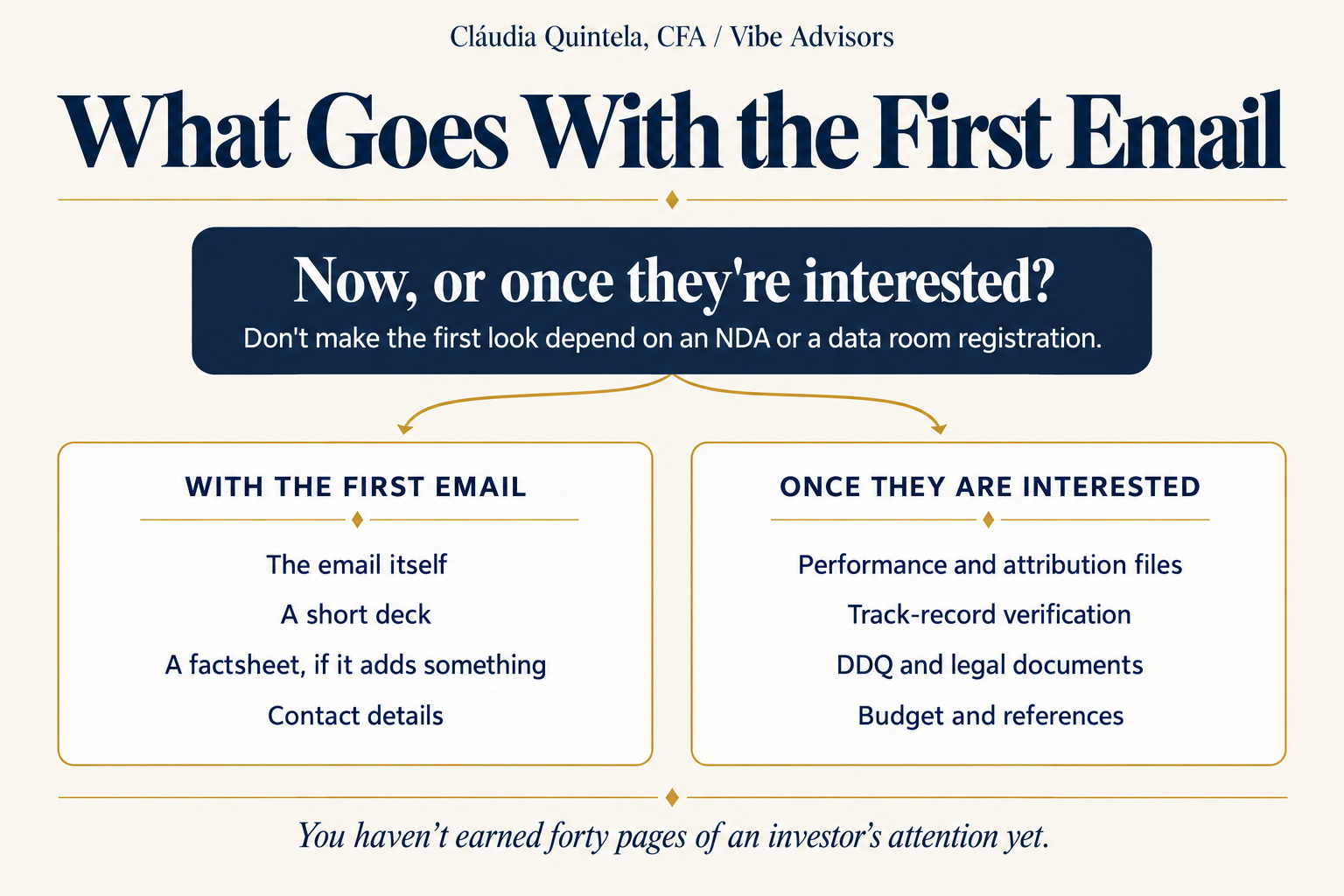
Follow the recipient’s submission instructions if they have any. Don’t make the first look depend on an NDA or a data room registration. Sensitive positions and anything restricted by a previous employer belong in a follow-up, once someone has asked for them.
The short deck
If the email works, someone opens the attachment. This deck is for the person who wants a little more before giving you an hour, so keep it short and push the detail into an appendix. It has to read without you in the room.
The first page matters most. After reading it alone, an allocator should know what you trade, why you expect to make money, why your team is qualified, what evidence exists and what you’re asking for. Put the team near the top. Allocators look for names and institutions they recognise before they read anything else, so don’t make them hunt for the bios on page fourteen. Add a page that says plainly what you have and what you need, with a timeline. An allocator who can see where the money goes, and when, finds it much easier to picture their own part in it.
If AI is part of your process, say exactly what it does. Half the decks I open now call themselves AI-native, which puts you in the same pile as all of them. What does the model do, and what does a human still decide?
A deck can look distinctive and still be uncluttered, with plenty of white space and pages you can read from the back of a meeting room.
The standard you’re up against
When I send a manager to an investor, I write a short summary they can read in the email without opening anything, one manager per email so they can trace it, and they come back with a yes or a no. That is the standard your own first email is competing with.
Reply with the first email you’d send me, 200 words and no attachment, and I’ll tell you whether I’d take the meeting.
Cláudia
Three ways to work with me
A fund manager who wants to work with me on the asset-raising side? Apply here.
Allocating to emerging managers? Get in touch.
Want an hour on your own situation, no ongoing commitment? Book a consulting call.
This publication is provided for educational and informational purposes only. The views and opinions expressed are those of the author and do not necessarily reflect those of any third party. Nothing contained in this publication constitutes investment, legal, tax or other professional advice, nor should it be relied upon as such. Nothing in this publication constitutes an offer, invitation, recommendation or solicitation to buy or sell any security, fund or other financial instrument, or to engage in any investment activity.