

An investor found me on LinkedIn. We got talking, he told me what he was looking for, I put one manager in front of him, and three months later he invested.
A couple of weeks ago I had to have a “tough” conversation with the same investor. I told him, smiling, that he cannot expect that every idea I put in front of him will be a great one. If I put one good idea in front of an investor in a year I have done a good job. Expectation management is important.
His answer is at the end of this email. But our exchange sent me back through the rabbit hole of my investor call recordings.
I have been recording these calls for over a year. Across those calls I present for 17.5% of the meeting. On a half-hour call that is five minutes of me describing what I do. The rest of the time we are both asking questions.
One investor asked me thirty-two questions in a single half-hour call. A little over one a minute.
Five questions recur, in roughly the same order, from one investor to the next. I thought this was interesting enough to share with you as a BTS (behind the scenes) of what capital introduction looks like before any ideas can be put in front of an investor.
1. What do you cover?
Which strategies, and at what size. Region comes in the same question.
This is standard mandate screening. My answer is liquid trading strategies, mostly FX, futures, commodities and macro, usually reachable through a managed account, with a sweet spot around $50 to $100 million of assets. Capacity constrained strategies and the odd Equity L/S with an unusual (non commoditized) angle. Nobody wants to hear about a good commodities manager when commodities sit outside the box they are allowed to fill.
This is usually followed by the structures offered by the managers: fund only? SMAs for what minimums? First Loss? Alpha Capture? Any fee or liquidity constraints?
2. How does your model work, and which side are you on?
One allocator asked me straight out which side I was focused on more. Another wanted to know whether I get paid from the manager’s side of the business. How I structure my pay comes up constantly.
They are checking two things. First, that they are not paying me a fee for my service, and if the managers pay me, whether that bends my incentives. Second, whether any investor ever does pay me, and under what framework. The answer to the second one is the bespoke search against a specific mandate, where the investor wants to take the whole capacity and we agree terms upfront.
3. How do you find the manager?
This is the one I get most.
The majority of managers find me, or come through a recommendation. This newsletter and the writing around it have turned into a real source of dealflow. Beyond that I put constant effort into knowing people the large prime brokers do not touch. If I am fishing the same water as Goldman and Morgan Stanley, I cannot bring an investor an idea they could not have got free from their own coverage. My ideas are only worth something if the sources are different.
4. How do you vet them?
I do not pretend to do investment due diligence on managers.
Everyone I represent is regulated and clears KYC, and most arrived through somebody I have known for years. I check references and counterparties before I take anyone on. I have walked away from managers whose numbers I could not verify, and from ones where the informal references came back very grey.
5. What have you got for me right now?
Nearly every investor call arrives here in the end.
My standard is deliberately low. One good idea a year and I have done my job. They see hundreds of managers, and one is a decent return on the relationship. If I am showing them the same names every prime broker is showing them, I am wasting their time and mine.
That is also what decides who gets on my book. High Sharpes with hard capacity limits, frequently sitting somewhere other than London or New York. A strategy that caps out at $300 to $500 million is invisible to a desk that has to place a billion, and that is why an allocator picks up my call.
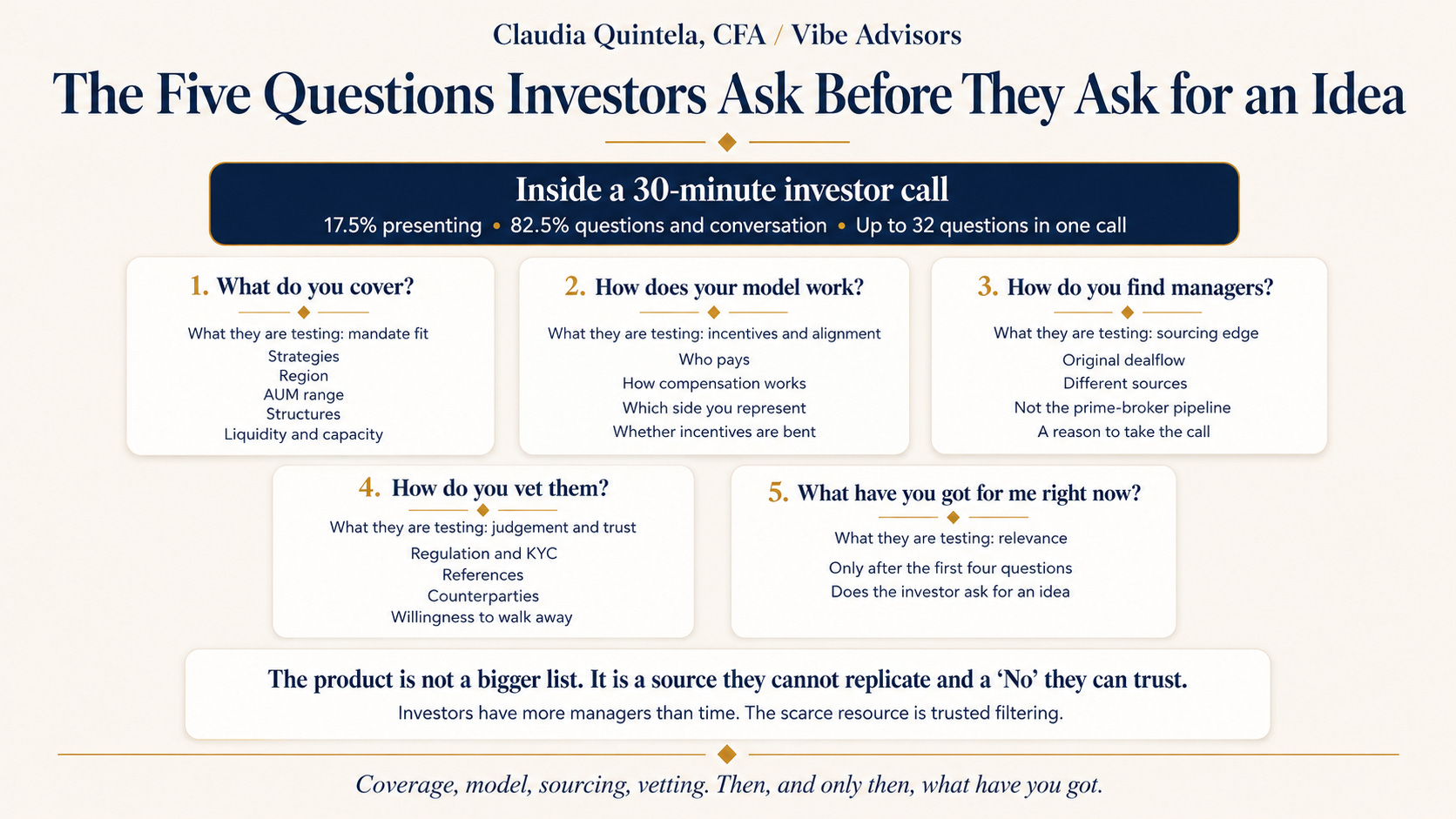
Count what those questions are about
Coverage, model, sourcing, vetting. Then, and only then, what have you got.
Now notice what is absent. No investor has ever asked me how big my list is, or for a headcount of the managers on it. And not one has asked me what my best idea is, which is a question I get constantly from managers about investors, and the one I flatly refuse to answer.
The size of the book is the thing this industry sells hardest, and it does not make the agenda.
That tells you what is scarce for investors: they have more managers to meet than hours to meet them in. What they are short of is somebody whose “No” they can trust. An allocator runs out of hours before anything else.
Some of you reading this newsletter are investors. Tell me your constraints, vehicle, ticket size, liquidity, what you already hold, and I will stay quiet until something fits what you’ve asked for.
Some of you run money and are used to getting interrogated at investor meetings. I don’t have an investment track record myself, but I’m not exempt from questions either. I thought you would like to know that you are not alone and I also have to prove myself before I get any meetings booked with investors.
What he said
Back to the man from LinkedIn.
He laughed, we both did. Then he told me to send him as many ideas as I want, even the ones I have not filtered. If I just want his opinion before I take them through KYC, send them over.
Investors spend that call auditing where I find people and how I screen them, and here is one telling me to skip the screen and send him the raw list.
There are two ways to read that and I cannot choose between them. Either the questions were always about where the names come from, in which case the sourcing is the whole product. Or they are the price of entry, and once you have paid it they start trusting the person, so the filter stops mattering as much.
I do not know which one it is. I am not going to pretend otherwise in a newsletter.
If you allocate, tell me which of those two describes you. If you run money, the same thing happens one step down. Whoever brings you into the room gets audited before you do, and you are somebody’s answer to question five.
Reply and tell me which of these questions surprised you most.
I read every reply.
Cláudia
Merci 💜Thank you!