

A manager I started working with recently sent me his prospect list, and one thing jumped out: it was a wall of large, institutional names. So I asked him why he’d gone that way.
His answer, roughly, was that these were the people he’d ended up in front of. No decision had ever been made about who he was actually selling to. For most of the firm’s history the pipeline sat empty and unqualified. When we looked closer, his existing investors had a completely different profile from almost every name in his pipeline.
Here was a manager doing everything right on the investment and operations side, and barking up the wrong tree on capital formation. He had simply never decided who his ideal investor was.
Most emerging managers I meet can talk for an hour about how they make money. Ask them who is most likely to actually invest, at their size, this year, and they go quiet.
I’ve sat in close to six hundred meetings in the last fifteen months, and this is the most common mistake I see: the manager has never decided who their buyer is. The pitch is fine, the numbers are good, and the pipeline is still stuffed with names nobody chose. They were the groups who happened to get in touch, or who the manager ended up next to at an event. Some were names carried over from a previous life at a bigger firm. Nobody picked them. The pipeline just filled with whoever showed up.
I call it the “barking up the wrong tree” problem. You spend a year in warm, polite meetings with people who were never in a position to back you, and you call it a live pipeline. It costs you assets and revenue. More than that, it costs the two things you can’t rebuild: your time and your energy.
Four things you are actually qualifying
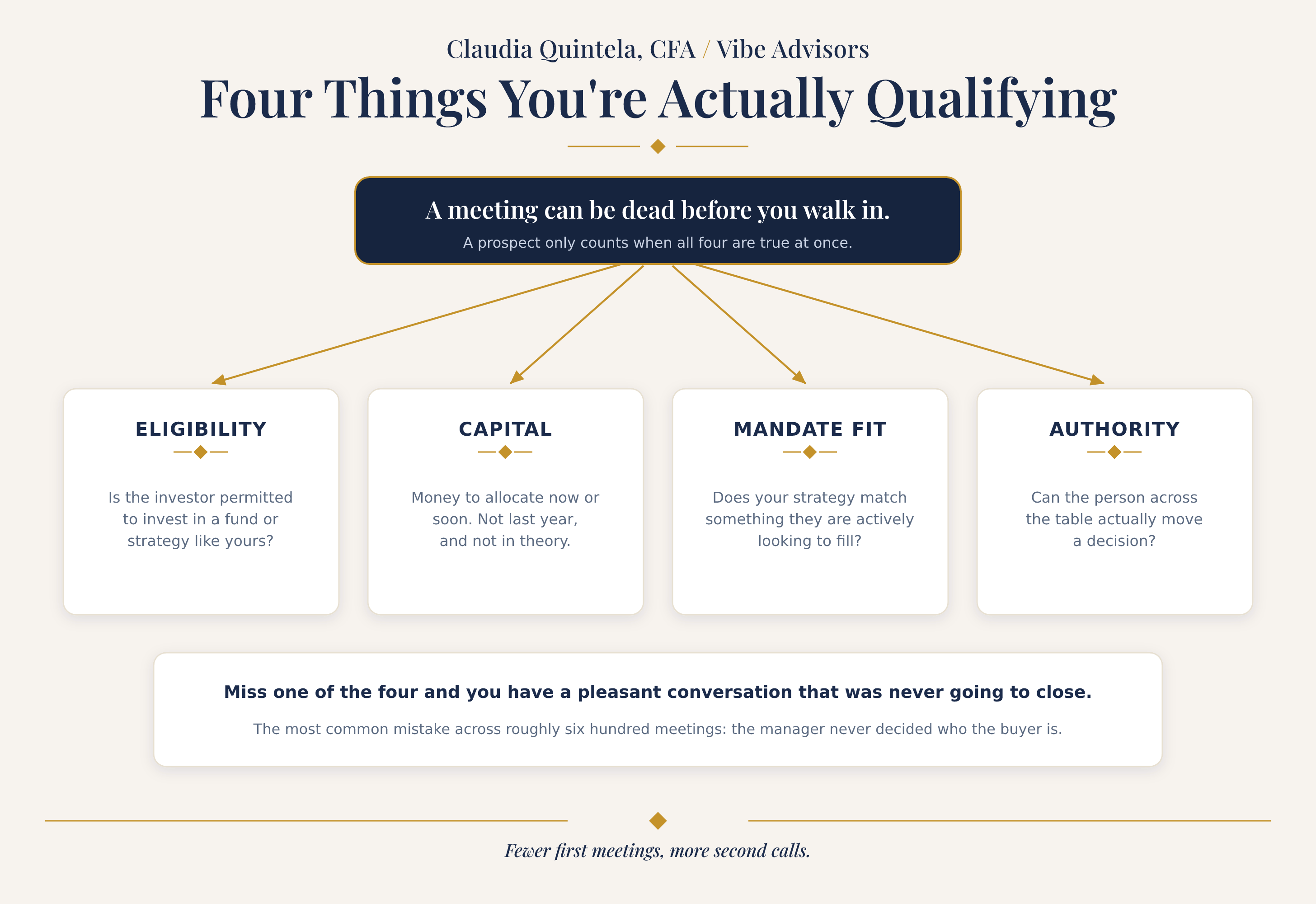
An investor meeting can be dead before you walk in, and you might be none the wiser. A prospect only counts when four things are true at once:
Eligibility. Is the investor permitted to invest in something like your fund or strategy?
Capital. Do they have money to allocate now or in the near future? Not last year, and not in theory.
Mandate fit. Does your strategy match something they are actively looking to fill?
Authority. Can the person across the table actually move a decision?
Miss one of the four and you have a pleasant conversation that was never going to close. A credible institution with no live mandate, or a keen individual with no capacity to invest, is not a real prospect.
Ask before you accept the meeting
You can qualify most of this before the meeting, and most of it without ever asking the investor. What you’re trying to work out:
What type of investor is it? Family office, fund of funds, wealth manager, pension, endowment, seed investor, proprietary or personal capital.
Do they invest directly, or advise another end investor?
Which strategies sit inside their mandate right now? Asset class, liquidity, geography, leverage, target return.
Do they allocate to emerging managers, and how do they define one?
What do they want out of the meeting?
The answers tell you quickly whether you are talking to a buyer, a consultant, an intermediary, or someone quietly gathering information.
Ask in the room
Once you are in front of them, let the investor talk first. Open questions pull more out than directed ones. Then get specific.
Mandate and fit:
What role would this strategy play in your portfolio?
Which strategies are you actively looking to add this year, and why?
What return, volatility and drawdown parameters do you require?
What would immediately rule a manager out?
Capital and capacity:
How large is the programme this allocation would come from, and how much of it is still unallocated?
What is your normal first ticket, and do you have a minimum manager size?
What percentage of a fund or manager are you allowed to own? A £20m minimum ticket can rule you out of a £30m fund, because the allocation would own too much of it.
Managed account, fund, or either?
Do you need other investors in before you will commit?
Emerging-manager appetite:
How many emerging managers have you backed in the last three years?
What is the smallest manager you have ever backed?
Would you invest before I reach your usual size threshold?
Do you require a minimum length of track record?
What do you accept as a track record?
Decision and process, which often matters more than the investment conversation:
What is the usual process, start to finish, for you to invest in a manager?
Which people and teams are involved?
Who owns the final yes, and is there an investment committee? How often does it meet?
Who runs investment due diligence, and who runs operational?
How many managers are you considering, and what would you need from us to move forward?
Timing:
Are you looking to allocate within a defined window?
What is the usual timeline for an allocation?
Is this a new allocation, or are you replacing someone?
The one question I would never skip
Have you ever done day one? Not “do you do day one”, because plenty of people will say yes to that. Ask it in the past tense. Have you actually been the first institutional cheque into a manager with no outside assets, and when was the last time?
If the answer is yes, ask why those particular managers got the day-one cheque. If the investor already knew them, or was invested in their previous fund, then it was never really a cold day-one bet, and that piece of information is crucial for you.
If they say “We’d certainly consider it,” or “in the right circumstances,” the answer is almost certainly no.
You are probably in an information meeting rather than in front of a buyer when they:
Won’t describe their mandate or their typical ticket.
Can’t tell you who actually makes the decision.
Claim broad interest across strategies that have nothing in common.
Have no defined allocation window.
Want your proprietary detail before they’ll share the basics about themselves.
Have never backed an emerging manager, or need AUM and infrastructure far beyond where you are now.
None of this is a reason to be rude, or to skip the meeting. Early on you take everything, because you need the reps and you learn the market by sitting in it. The point is to know what you are in, and to spend your sharpest energy on the people who can actually move.
Own money versus someone else’s
Broadly, two kinds of people sit across from you. One is spending their own money and answers only to their own conviction. They can be first, and if they believe you, they simply do it. The other is deploying someone else’s capital, with a committee behind them and career risk if a first-time manager they championed blows up. That second person can stay warm and interested for eighteen months and never be your first cheque. Both are worth knowing and building into your pipeline. Only one is worth chasing right now.
As you take on more meetings, you’ll meet the friendliest faces who may never invest. They matter too, just not as pipeline. They’ll open a door or hand you a reference, and that is worth a great deal.
Before you leave the meeting
One final question separates a real prospect from a polite one, and it is the strongest way to close any first meeting:
“Based on what you’ve heard, is this a good fit for what you’re looking for right now? If so, what are the exact steps, and what would you like to see from us?”
A genuine investor gives you a clear answer, even when that answer is “not yet.” Someone who was only ever collecting information won’t.
A run of warm meetings feels like momentum. It’s the most expensive illusion in fundraising, because it burns the one thing an emerging manager can’t rebuild: the belief that the process is going somewhere. Stop confusing a pleasant conversation with a live one. Fewer first meetings, more second calls.
If you made it this far, do one thing right now. Write one sentence: the investor most likely to write your next cheque, at the stage you are today. Then look at your last ten meetings and count how many fit it.
Reply and tell me the number. If you can’t write the sentence at all, that’s the real problem, and it’s the most fixable one you have.
Cláudia
Many emerging managers miss the mark by not targeting the right investors. Understanding eligibility, capital, mandate fit, and authority can save time. Have you considered refining your prospect list to focus on ideal investors?