


By Cláudia Quintela and Morgan Parry, Brand & Content Partner for Investors and Finance Executives.
A fortnight ago Alfonso Peccatiello went through what a large institutional allocator demanded of him before the money moved, from live trade reconciliation to a succession plan written down.
At the end I asked him what a manager can actually control, given how much of an early track record comes down to luck.
“What you can control is: have you hired the right people? Do you have the right operational setup? How are you reaching out to investors? Do you have a distribution mechanism? Do you publish research? What’s your communication style? (...) All these things you can control.”
Hiring and operations cost money. Publishing research and choosing how you communicate cost you an hour a week, and sit entirely inside your own decision.
You cannot control your first year of returns, or whether the allocator’s committee meets in November or February. A fund with your numbers and a longer track record will be preferred to you for reasons that have nothing to do with you.
In July, Melanie Goodman and I published It Pays to Lurk. Hedge funds are open-ended, so an allocator is never forced to move and has no reason to raise their hand. They read you for months without reacting and reach a verdict you were not consulted on. Melanie covered the mechanics: what your headline has to say for a family office analyst to find you at all, and why your Featured section needs something in it. A lurker who reaches your profile and finds nothing to read has established only that you exist.
The replies I got all said the same thing: people liked it but could not make themselves publish. So the LinkedIn profile gets fixed in an afternoon and then nothing happens for nine months. That gap is what this issue is about, and I asked Morgan Parry to take it on with me.
Morgan ghostwrites for senior finance people, including senior people at one of the UK’s fastest-growing banks. He is also the brand and content partner for Dragons’ Den investor Richard Farleigh, who is publicly his client. His clients range in age from 37 to 66. They run serious money or have built something serious, and they go quiet the moment you suggest they publish, which makes them look a great deal like the people reading this newsletter. He has a framework for what stops them, built from doing this for a living. I have spent years on the other side, watching what the silence costs hedge fund managers who could not afford it.
I tell this from my side. From here on, the indented quotes are Morgan’s. He names four things that stop people like you, and I have taken them in order, with what each one means if you run a fund.
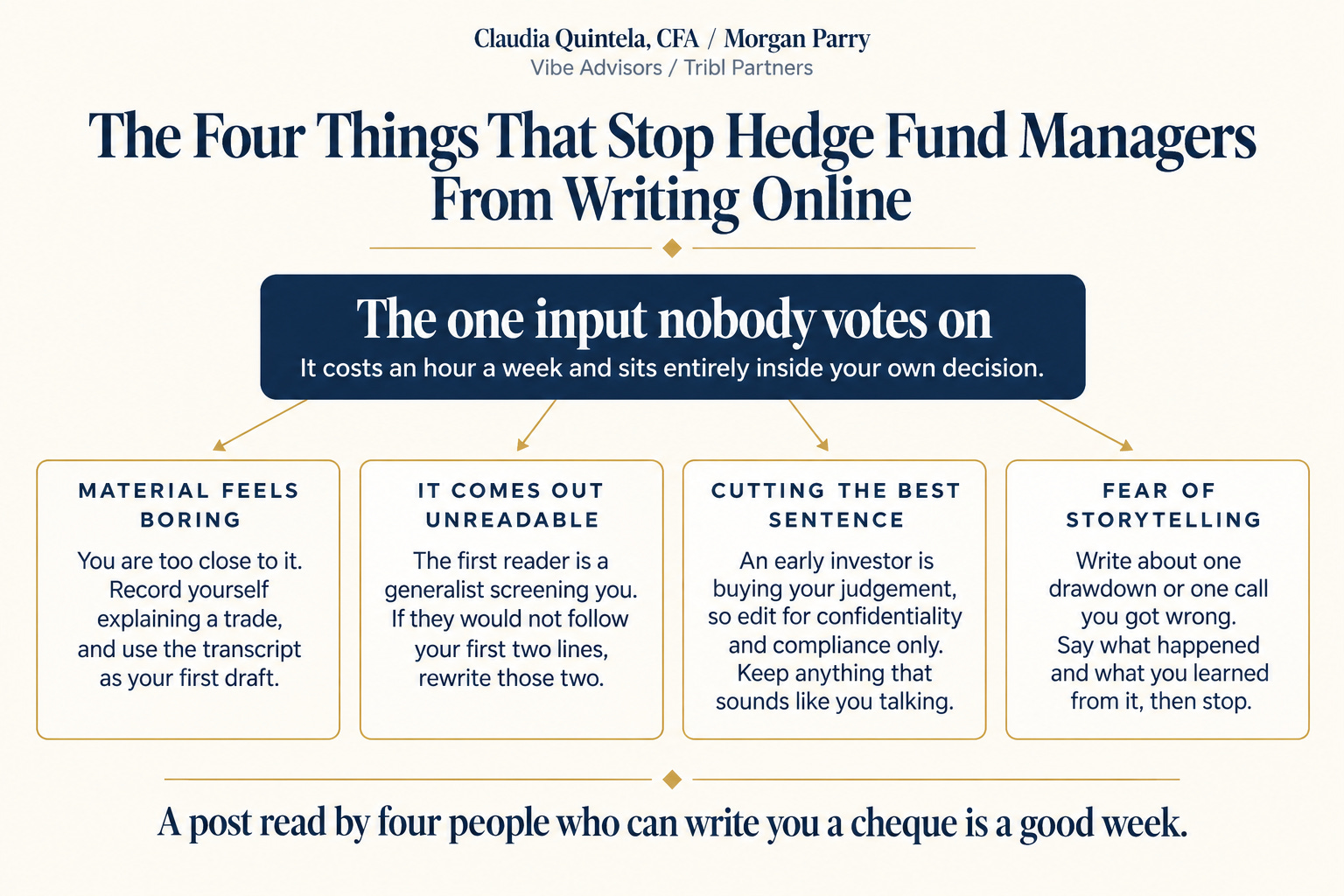
1. You think your best material is boring
Morgan calls it proximity bias.
“We’re too close to our ideas, stories, and opinions. We take the stories and ideas in our heads for granted because they’re too familiar. (...) We’re used to them, they seem boring to us, so we don’t share them.”
His fix is to say it out loud before you try to write it.
“Have you ever talked to a friend about a problem? And just by verbalising the issue, you somehow solve it on your own, without your friend intervening? (...) Just by verbalising our ideas, we reduce that proximity bias. We get the ideas out of our heads and in front of us.”
I learned this by accident. I went on a podcast and said what I thought was entry-level material, the things I had said in meetings a hundred times without anyone writing them down. It went further than anything else I have done. The messages afterwards said nobody had ever said it out loud, and then: I have lived through that.
For a manager there is a buyer at the end of this. When an allocator digs into your idea generation, they are testing whether the process is repeatable or whether it lives only in your instinct. This is especially true for discretionary hedge fund managers.
The answer to this is in the material you consider too obvious to write down. Why you sized a position the way you did, or the trade you did not put on and why. To you that is basic knowledge. To someone deciding whether your returns can be repeated, it is the only evidence that exists outside your own claims about yourself.
If you run a fund: the next time you explain a trade to a colleague, record it on your phone. The transcript is your first draft. Most of what I publish was said in a meeting long before it was written down. I also recommend you read Sebastian Mallaby’s “More Money Than God” to get inspired by how some hedge fund titans always had a prolific writing habit to clarify their ideas.
2. It comes out unreadable
“Because you have that deep seated expertise, what you think is going to come out as this clear, simple palatable framework comes out more conflated, confusing and hard to digest. You forget that you are the expert and the readers are not. We don’t want to dumb it down, but we want to simplify.”
Morgan’s test is whether a complete beginner could stumble onto your post and learn something from it while an expert in your field still finds it worth reading. His advice is to go deep on one subject at several levels, from beginner to expert, rather than wide and shallow across many.
In our industry, “beginner” means a generalist allocator. Picture two readers. One is the CIO of a family office who covers everything from private equity to long only. The other is the quant equity specialist at a multi-manager. If you run systematic equity, write so that both of them take something from the same post.
I call this flexing. You change the style of the communication and leave the substance where it is.
Some of the managers I work with build investment models for a living and would happily never speak to another human being. Put them in front of an allocator and they have two fears at once: saying too much, and giving away the secret sauce.
Your secret sauce took thirty years to build. Nobody is taking it off you in one conversation.
The second fear costs you serious money, as it misreads who is reading. Before you reach anybody at an institution who can follow your language, you pass several people who cannot, and any of them can stop you. That means the analyst doing the first screen and the person assembling the shortlist, and often the first of them is me.
Tell me what you are trying to achieve with your code, the philosophy and the method, so I can decide whether this is worth a second meeting. If you open a page of source in front of me, all I learn is that you cannot explain it.
Managers make this mistake in first meetings and then repeat it in public. Writing what only someone already running your strategy can follow is a shop window the analyst walks straight past. You have to be findable, and then readable in the few seconds you get.
If you run a fund: before you post, ask whether the generalist CIO would follow the first two lines. If they would not, rewrite those two lines and leave the rest alone.
3. You cut the best sentence
“I’ve hosted hundreds of content interviews to pull out my clients’ stories, opinions, and frameworks. And quite often, they’ll break something down in a natural, authentic, human way, and with total clarity. The reason it’s so clear is because we’re in a relaxed conversation. (...) I’ll remember the incredible sentence they said, and include it, verbatim, in a draft, and then send them the draft. What happens next? They want to remove that one incredible sentence. The one they said.”
I see this constantly and had never thought about why until Morgan raised it. My generation (Gen X) was trained to write differently than they speak. Speeches were written first and polished until nothing much was left in them. Morgan runs that machinery backwards and turns speech into writing, so when a client reads their own spoken words on a page, it looks to them like a mistake.
You have seen this hundreds of times. It’s the quarterly letter that has been through compliance and two more drafts until it says the fund performed in line with expectations given the volatility environment. Does that language allow anyone to form a view about a manager?
An early investor is buying your judgement. Alf was blunt about it: the investors writing the first large tickets are “basically underwriting your business” before the numbers can prove anything, and in exchange they want good terms and capacity. If every sentence that sounds like a specific mind is removed before it reaches them, you have sent a document that could have come from anyone.
Some cuts are legitimate. Most of my material comes out of calls, so I anonymise constantly. I merge two people into one, and occasionally swap a he for a she until the story is untraceable.
If you run a fund: when you edit, delete for confidentiality and compliance only. If a sentence sounds like you talking, it should stay. Do not be afraid to show your personality and your beliefs in your writing. They are what make you unique and memorable to someone else.
4. Storytelling makes you cringe
Say “vulnerability” to a fund manager and watch what happens.
“Storytelling is a massive buzzword that gets thrown everywhere. (...) It’s simply a method of transferring information to the reader in a memorable, palatable format. It’s just an empty vessel. You can have a story about your cat or you can have a story about your business. It’s just a tool. What’s in the story is what counts.”
Senior people flinch, Morgan says, because they picture
“those LinkedIn posts when the person makes it sound like a dramatic scene out of a Christopher Nolan movie rather than a simple, understated, humble lesson. (...) We see it, we cringe. It feels totally fabricated.”
His example of the register everyone is afraid of: “I sold my company for sixty million, but I could not bear to look myself in the mirror.” Nobody in finance wants to be caught writing that humblebrag, so they publish nothing at all.
Morgan strips vulnerability back to something you can actually do:
“In a nutshell, all we are doing is simply sharing personal guarded information with no guarantee of a positive outcome. It’s that simple, and we can all do it without the bells, whistles, and crocodile tears.”
That definition describes your job. You take positions that can be wrong and publish a number every month that can be ugly. Writing a view that could look embarrassing in six months is the same act, done where people can watch.
The best version of this is a manager writing plainly about a drawdown while still in it. That tells an allocator the thing they most want to know, which is what you are like to deal with when it goes wrong.
Jon Gray, one of the top people at Blackstone, posts videos of himself running, out of breath and rarely in a tie. He says almost nothing about the business in them. He is a real person on a screen, which almost none of his peers will do, and it is impossible not to like him.
If you run a fund: write about one drawdown or one call you got wrong. Say what happened and what you learned from it, then stop.
You are counting the wrong things
In July I told you to stop watching impressions. “Ignore the numbers” is useless advice on its own, and it is the reason most hedge fund managers quit writing in month four. So what do you count instead?
Morgan calls them the softies:
“Self-reported soft data. The kind of metrics you cannot track, you cannot plug in a tool to explain them. It’s the client who walks in and says, that story you shared. Or the DM from a VC who says, that framework you sent.”
They do not all weigh the same, and it took me a while to work out the ranking. Close friends reply to the email. Serious industry contacts almost never reply, but they mention it the next time you are in a room together, or a WhatsApp arrives three weeks later saying they read it. And then you realise they spent 30 minutes of their time reading something you wrote. This is very powerful, because nobody obliged them to read it nor to say anything about it either.
Then there is the stranger, someone who does not know you from Adam, who took the trouble to write and say they had printed the piece and given it to their children or coworkers. Whatever you are afraid of when you publish, they overcame a version of it to tell you.
The hard numbers can mislead you. I have under five thousand followers on LinkedIn, a rounding error next to people I watch grow every week. Someone building a media company needs followers. I sell a service with finite capacity, so I need qualified leads, and so does an emerging hedge fund manager. If you are raising a fund you are playing my game, and the number of people who can write you a cheque is somewhere in the hundreds worldwide. A post read by four of them is a good week.
I still open LinkedIn most mornings and feel it, and so does Morgan: someone else got more impressions and is growing faster. I get over it quickly.
What I watch is inbound. Ten enquiries arrived in a single day recently. Investors with a mandate, asking who fits it. People whose role and firm I knew but whose names I could never have found, because this industry is deliberately opaque about who actually decides. When I asked, most of them said an AI assistant had recommended me. LinkedIn is behind that as well. Search engines and AI assistants read what I publish there, and when someone finds me through search, my LinkedIn says the same thing my website does, so each one confirms the other. I now get 10 to 20 inbound leads a week, and I could not tell you where one channel ends and the other begins.
That has created a problem I did not plan for. My service is high touch and my capacity is finite, so I now have a pipeline of people I have nothing to sell.
What I actually do, that you can do too
I talk first and write second. Everything I publish starts as a voice note or a call, and I use Wispr Flow* to turn it into text. The polishing comes afterwards, and that is where the danger is, because polishing removes the parts that sound like a person.
Your raw material is in your inbox, on your calls. It’s also in your internal meetings so record those too. People reply to this newsletter or my posts telling me what they are struggling with, and I use their specific words when I write. How a real person describes a problem beats any framing I would have invented. Your version of this is your investor emails and meetings. Every question an allocator has put to you twice is an article or post waiting to be written.
Use their words for things, too. I once asked an investor whether they did a particular kind of arrangement. No, they said, we do not do that. What is it? I described the mechanics. Oh, is that what you call it? Yep, we do it. Allocators search for the words they use, so put those words in your headlines.
If you run a fund: open your sent folder, find the last allocator question you answered at length, and post the answer with anything identifying any individuals taken out.
Morgan’s 4Rs, in five minutes
Morgan built a framework for people whose reputation is the asset and who are terrified of looking like influencers:
“If you incorporate these Rs in your brand and content, you’ll not only protect your reputation, but actively grow it, and most importantly, build influence with the right people.”
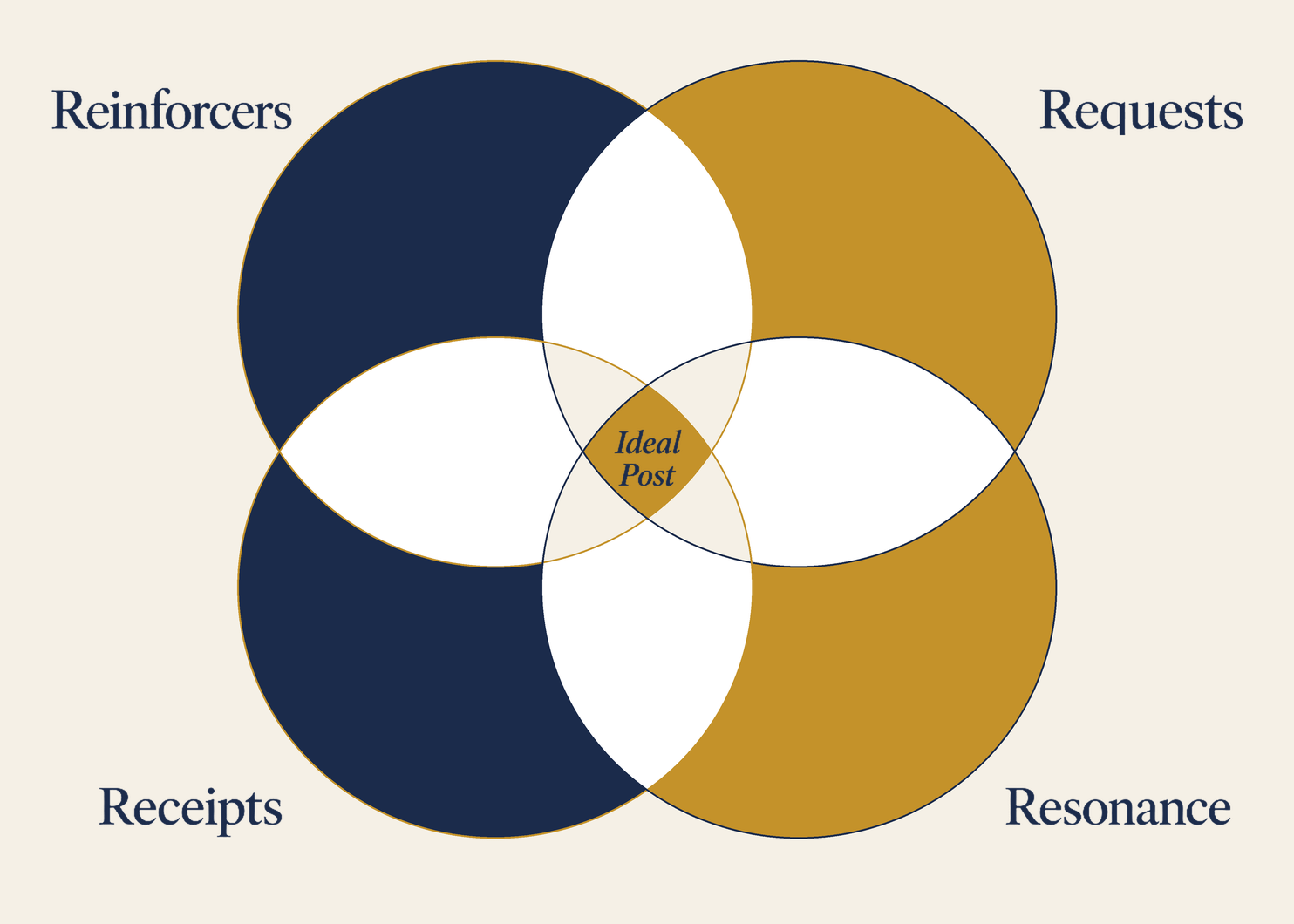
Reinforcers. Show that you control something scarce that your reader wants. Morgan borrows Alex Hormozi’s bartender: on a busy Friday everyone in the bar is waving money at him, and the next morning on the street nobody looks twice. Status depends on the room. For a manager, the scarce thing is what you know about the markets you trade. Your profile already lists the credential, and giving some of the knowledge away is the only way anyone finds out you have it.
Receipts. Proof that you have done valuable things before. Early on, a receipt can be effort: “we spent months stress-testing this, and this is what broke.” For a manager that means the years you have run the strategy and the research you have already published. Morgan’s own Featured section holds his newsletter and a video endorsement from Richard Farleigh. Anything that shows your fund’s performance or reads as an invitation to invest may be seen as a financial promotion and has to go past your compliance officer before it goes out.
Requests. Everything you publish builds towards a future ask: take my call, read my newsletter/tearsheet. You raise the odds of a yes by giving something useful first. Morgan calls it “say-do” correspondence. When the reader acts on your recommendation and it works, the next ask gets easier to say yes to. This issue is an example. Morgan and I are asking you to publish something on LinkedIn.
Resonance. The reader sees themselves in you, or sees the person they want to become. Morgan has worked with a private investor for about six months whose content has passed 16 million views and 25,000 comments, of which only a dozen were hostile. His explanation is that the investor shares plenty of lessons and failures and keeps every one of them understated.
The Rs work best in combination. A reinforcer on its own reads as boasting: I have what you want and I am not telling you how to get it. Pair it with a request, a practical way for the reader to get there too, and the same post reads as generosity.
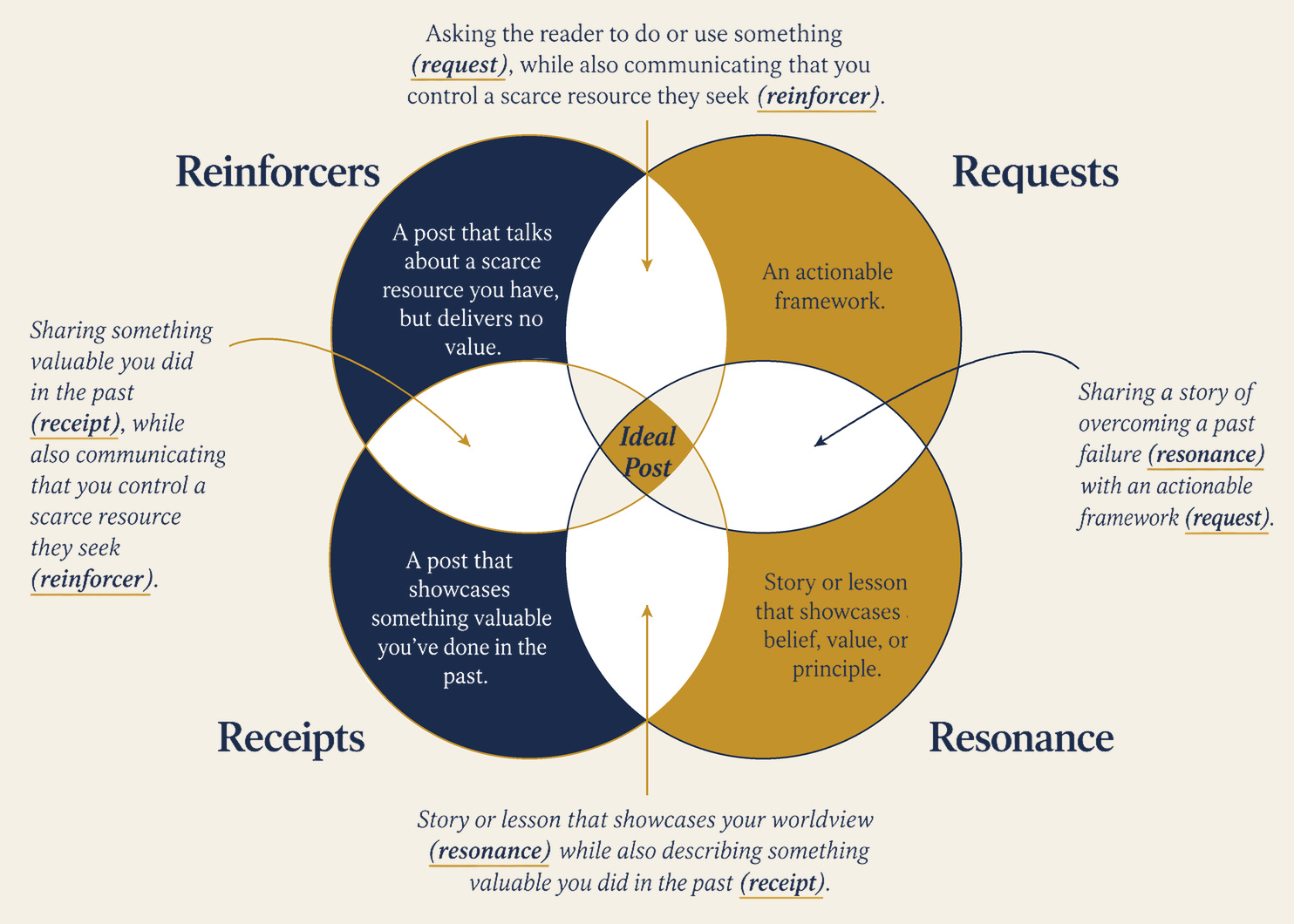
Bill Ackman puts all four into one podcast appearance. He tells the story of one of the lowest points of his life and what he learned from it. Who he is supplies the reinforcer and the receipt. The low point is the resonance, and the lesson he draws from it is the request.
The one input nobody else votes on
The allocator who anchored Alf’s fund found him through his research. They were on regular calls for a year before the fund existed, and the relationship ran for three years before he invested. Being findable started the relationship but consistent quality research is what kept him reading and engaged.
Everything else in your capital raise is decided by other people, from the committee’s calendar to the consultant’s shortlist. What you publish about the markets and how you work is the item on Alf’s list you can start this week. It costs you an hour and the discomfort described above.
If you fixed your LinkedIn profile in July and your Featured section is still empty, start there. Take one of the five “If you run a fund” steps above and pin whatever it produces to your Featured section.
I put one question to Morgan that he could not answer. Is this fear of publishing cultural, or is it gendered? I am Portuguese. I can have an argument about a fried egg, and an English boardroom is a different environment entirely. I am also one of very few women publishing in my corner of this industry. Most of my audience is male and so are Morgan’s clients:
“I don’t have enough data to say. I’ve worked with well over a dozen male CEOs and investors, but only three women, all CEOs. Three is far too small a group to draw a conclusion about gender from. What I can say is what I’ve seen in the men. They’re more fearful at the start. But once they see commercial and social returns, they adjust very quickly.”
So we cannot tell you whether we are describing a generation or a gender fear.
You can.
Reply to this email and tell us which you think it is, and what stops you from publishing. I read every reply.
Cláudia and Morgan
* Affiliate link. Sign up through it and you get a free one-month trial of Wispr Flow Pro. I earn enough from it for a couple of Nespresso pods, and nowhere near enough for a pair of Manolos.
Three ways to work with me:
A fund manager who wants to work with me on the asset-raising side? Apply here.
Allocating to emerging managers? Get in touch.
Want an hour on your own situation, no ongoing commitment? Book a consulting call.
This publication is provided for educational and informational purposes only. The views and opinions expressed are those of the author and do not necessarily reflect those of any third party. Nothing contained in this publication constitutes investment, legal, tax or other professional advice, nor should it be relied upon as such. Nothing in this publication constitutes an offer, invitation, recommendation or solicitation to buy or sell any security, fund or other financial instrument, or to engage in any investment activity.
What makes a dated post useful to an allocator is that it can be checked later. A view published before the outcome can be set against what happened, which no explanation written afterwards can offer. Do allocators in your experience go back and judge that record, or is the read more about how consistently the manager thinks?